A million faces at my feet and all I see are dark eyes. Bob Dylan’s Dark Eyes c 1985


It was near the beginning of the plague in 2020, not staying at home and with so much going on when I first began thinking of putting this website together. A few other world developments have occurred since then as well.
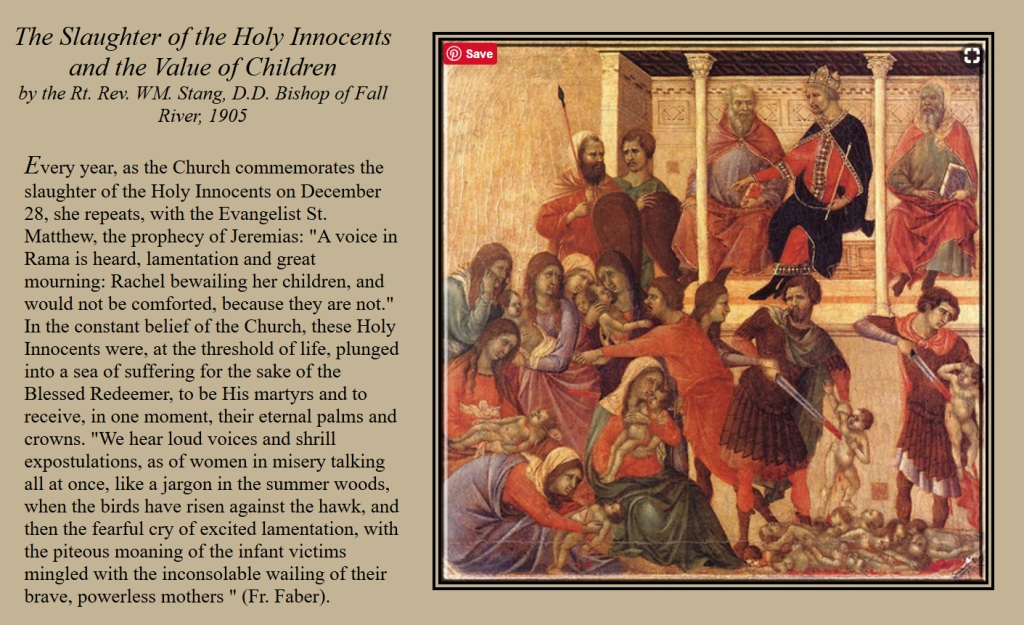
When I had the idea to connect the talk with Garcia with information about Jesus Christ, the Divine Mercy, the Divine Will and “who gets saved”…. I had a dream. In the dream, I saw a smiling and encouraging Garcia and a young girl with him. Maybe just my subconscious or a bit of encouragement from the other side perhaps. St. Joseph had a dream, to take the Virgin Mother and child to Egypt to avoid the slaughter of the holy innocents and their Son’s slaughter at the hands of Herod. See Matthew chapt 2 v 13-5. God works in dreams, sometimes a series of dreams, thru people and in all good ways. He also works through suffering too.
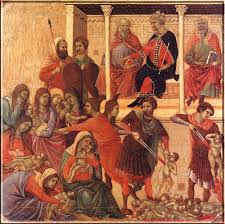
Picture: Slaughter of the Innocents
I learned to fear (fear = deep sense of reverence, awe and respect of) Jesus in a small town. John Mellencamp, Jack and Diane
Fear of the Lord in Christian theology is about cultivating a respectful and loving relationship with God, characterized by awe and a commitment to live according to His ways. (deep sense of reverence, awe and respect of) Grok 2025
“I never thought much about releasing this interview, as I worried that many impressionable fans of Garcia might be swayed toward a more syncretistic, ‘anything goes,’ morally relativistic worldview—if they hadn’t already been.”
As every day passes Garcia’s fan base gets smaller. It’s just a numbers game. For example, I was playing music at a restaurant and asked a mid 20 year old musician if he had heard of Jerry Garcia. He asked, “Isn’t he a comedian”? I said, “no, he founded The Grateful Dead”…He said. “Oh you mean the dancing bears thing”? I figure some fans of Garcia would enjoy hearing and reviewing some of this information. I also pray fallen away Catholics return to the sacraments of the Church and other non Christians look into and embrace Jesus Christ. The sacraments truly are mystical, life-giving and grace-filled.
When David Crosby and later Robbie Robertson, both friends of Dylan passed I thought of their encounter, their experience at death, and right before and after as well. Only a fool or someone so consecrated to evil, would reject God’s/Christ’s love and mercy.
One Franciscan priest friend put it this way – he said, “In the last billionth of a second of a person’s earthly life, Christ can be his own apostle and appeal to a soul”.
“‘I am love and Mercy Itself. There is no misery that could be a match for My mercy, neither will misery exhaust it, because as it is being granted – it increases. The soul that trusts in My mercy is most fortunate, because I Myself take care of it.’” Diary of Saint Maria Faustina Kowalska: Divine Mercy in My Soul Book by Faustina Kowalska (No. 1273)
Other reasons to share this now

People get ready, there’s a train a comin.
The mountains are filled with lost sheep
Its Not Dark yet But its getting there
The times they are a changing
The hour is getting late
They are breaking down the distance between right and wrong..
Wanted to know my song well before I started singing
Also, with the marked increase in active diabolical disorientation manifesting in so many corners of the world and in so many lives, I decided it would be good to share this information—before a theophany, a worldwide illumination of conscience, a solemn warning, or, God forbid, a global conflagration. If even one person is moved even an inch closer to Jesus Christ by reviewing it, then it was well worth releasing.
St. Augustine, in his Sermon 201 and Letter 149, discusses the dream of Pontius Pilate’s wife, Procula, as referenced in Matthew 27:19, where she warns Pilate not to condemn Jesus due to a dream she had.
The redemptive purpose of Christ’s Passion, might have inspired the dream to prevent the crucifixion. Augustine leans toward a divine origin, emphasizing that the dream served God’s purpose by underscoring Jesus’s righteousness and exposing Pilate’s moral failure, as Pilate ignored both his wife’s plea and his own conscience.
St. Thomas Aquinas addressed the dream of Pontius Pilate’s wife, traditionally named Procula or Claudia, in his Catena Aurea (Golden Chain), a compilation of commentaries from the Church Fathers on the Gospels. Regarding Matthew 27:19, where Procula sends a message to Pilate urging him not to condemn Jesus because she “suffered many things in a dream because of him,” Aquinas synthesizes two perspectives to provide a balanced interpretation.
Aquinas suggests that the dream could have been caused by God through good angels, intended to warn Pilate and Procula of Jesus’s innocence, thereby making Pilate more accountable for his actions since he could not claim ignorance. Alternatively, he posits that the dream might have been induced by the devil, who, in his confusion and opposition to Christ’s Passion, sought to prevent Jesus’s crucifixion, which was necessary for humanity’s redemption. Aquinas reconciles these views by noting that, regardless of the source, the dream served a divine purpose: it highlighted Jesus’s righteousness and increased Pilate’s culpability for ignoring the warning.
In his broader theological framework, Aquinas also considered precognition, or “natural prophecy,” as a natural human ability that varies among individuals, akin to heightened sensory perception. He suggested that Procula’s dream might reflect such a natural sensitivity, though he did not definitively attribute it to this alone, allowing for divine or demonic influence as well.
Thus, Aquinas presents a nuanced view, avoiding dogmatic attribution of the dream’s origin while emphasizing its role in the divine plan, either by divine providence or by exposing the devil’s futile attempt to thwart the Passion.
Augustine suggests that the dream was likely sent by God as a divine warning to highlight Jesus’s innocence and to increase Pilate’s accountability for his unjust decision. He contrasts this with the possibility of demonic influence.
St. Augustine and St. Thomas Aquinas, two of the most influential theologians in Christian history, offer distinct yet complementary perspectives on the dream of Procula, the wife of Pontius Pilate, as recorded in Matthew 27:19. Procula’s dream, in which she reportedly received a divine warning about Jesus’ innocence, has been a subject of theological reflection, particularly regarding its origin, purpose, and moral implications. While neither Augustine nor Aquinas provides an exhaustive commentary solely dedicated to this episode, their broader writings on divine providence, dreams, and human responsibility allow us to infer their likely interpretations.
St. Augustine, in his works such as The City of God and On the Trinity, frequently discusses dreams as potential vehicles for divine communication, though he is cautious about their interpretation. Augustine would likely view Procula’s dream as a genuine divine intervention, given its context in the Gospel narrative and its alignment with God’s plan to highlight Jesus’ innocence. In his commentary on Matthew, Augustine emphasizes God’s sovereignty in using even pagan figures to fulfill divine purposes. He might argue that the dream was sent to Procula to stir her conscience and, indirectly, Pilate’s, serving as a testimony to Christ’s righteousness. However, Augustine would also stress that the dream’s effect was limited by human free will—Pilate’s failure to act on his wife’s warning underscores the moral responsibility of individuals to respond to divine promptings. For Augustine, the dream is a small but significant moment in the Passion narrative, illustrating how God’s truth can penetrate even the hearts of those outside the covenant.
St. Thomas Aquinas, in his Summa Theologica (particularly in discussions of prophecy and divine inspiration, e.g., II-II, Q. 172-174), provides a more systematic framework for understanding Procula’s dream. Aquinas categorizes dreams as possible conduits for divine revelation, especially when they serve a salvific purpose. He would likely classify Procula’s dream as a prophetic vision, granted by God to affirm Christ’s innocence and to offer Pilate an opportunity for moral rectitude. Aquinas might argue that the dream was an act of divine grace, not because Procula was inherently virtuous, but because God willed to use her as an instrument in the redemptive narrative. However, like Augustine, Aquinas would emphasize that the dream’s efficacy depended on human cooperation. Pilate’s disregard for the warning exemplifies a failure to align with divine truth, a point Aquinas often makes about the interplay between grace and free will.
Both theologians would agree that Procula’s dream was divinely inspired, serving to underscore Jesus’ innocence and God’s universal call to truth. They would also concur that its ultimate ineffectiveness in altering Pilate’s decision highlights the limits of divine signs when met with human obstinacy. Augustine might focus more on the dream’s role in the broader drama of salvation history, while Aquinas would likely offer a more technical analysis of its prophetic nature. Together, their views frame Procula’s dream as a moment of divine clarity in the Passion, revealing God’s desire to guide even those on the margins of the Gospel narrative toward truth, while respecting the freedom that ultimately shapes their choices.
above from GROK and Catholic Resource